Using LLMs to Understand the Brain
Using Generative Models to understand Musical Predictions
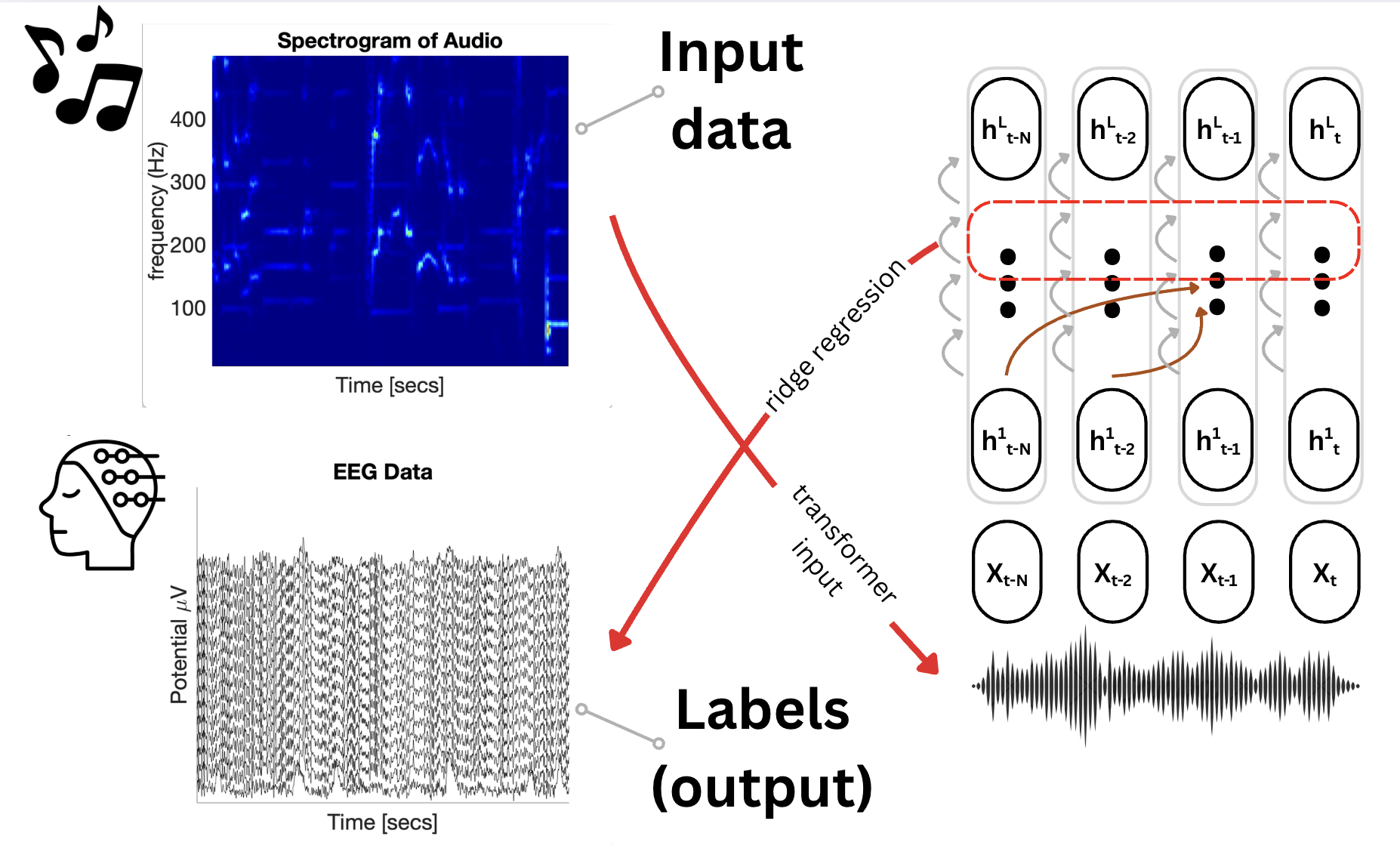
The human brain is thought to process sensory stimuli by making predictions.1 Specifically, predictive coding theory posits that the neocortex hierarchically compares input signals against top-down signals from a generative model.2 To test for the existance of this generative model in the brain, researchers have compared activity in large language models to neural activity in human listeners during speech perception. 3 Less is known about whether large language model representations of music similarly map onto the human brain. In this project, I used MusicGen 4, a multi-stage transformer trained on autoregressive acoustic prediction, to test whether musical predictions are encoded in EEG activity.
Footnotes
-
Clark A. Whatever next? Predictive brains, situated agents, and the future of cognitive science. Behavioral and Brain Sciences. 2013;36(3)
. doi.1017/S0140525X12000477 ↩ -
Rao, R. P. N., & Ballard, D. H. (1999). Predictive coding in the visual cortex: A functional interpretation of some extra-classical receptive-field effects. Nature Neuroscience, 2(1), 79–87. https://doi.org/10.1038/4580 ↩
-
Caucheteux, C., Gramfort, A., & King, J.-R. (2023). Evidence of a predictive coding hierarchy in the human brain listening to speech. Nature Human Behaviour, 7(3), 430–441. https://doi.org/10.1038/s41562-022-01516-2 ↩
-
Copet, J., Kreuk, F., Gat, I., Remez, T., Kant, D., Synnaeve, G., Adi, Y., & Défossez, A. (2024). Simple and Controllable Music Generation (No. arXiv
.05284). arXiv. http://arxiv.org/abs/2306.05284 ↩